$100,000 Bill
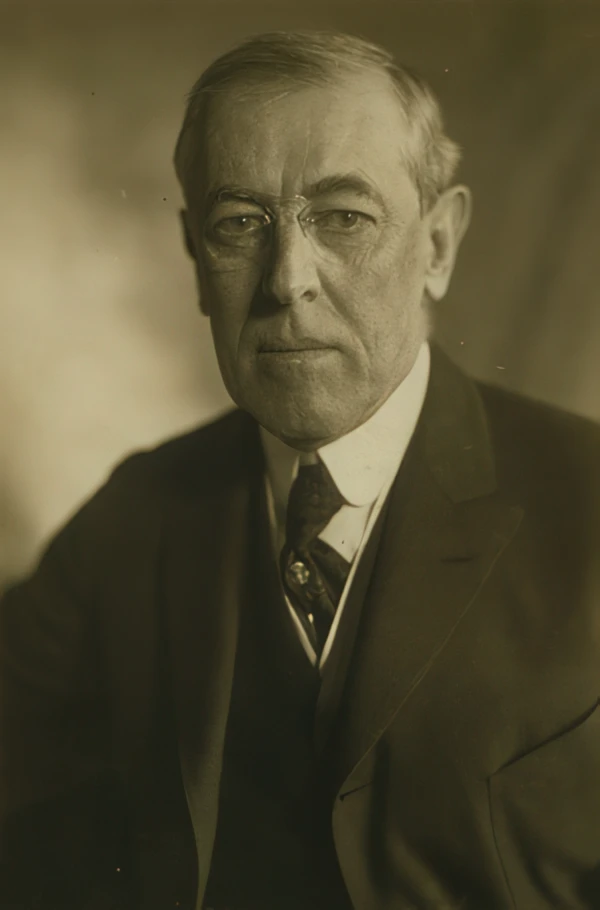
Woodrow Wilson was born in Staunton, Virginia in 1856 to a Presbyterian reverend of Scots-Irish descent. He graduated from Princeton, where his father was a professor, in 1879, then attended law school at the University of Virginia for a year. He did not graduate but easily passed the Georgia bar anyway. Finding little work as an attorney, he entered a Ph.D. program in history and political science at Johns Hopkins University in 1883 and graduated just three years later. He then completed teachings stints at Cornell, Bryn Mawr ($2,000/year), and Wesleyan ($2,500/year) before joining the faculty at Princeton ($3,000/year) in 1890.
In addition to his teaching salary, Wilson in the 1890s earned an average of about $1,500 per year from book royalties (he had penned a political science textbook for D.C. Heath while at Bryn Mawr) and speaking fees. Earning as much as $4,000 extra in one year, however, pushed him to the limit. Wilson was not as frail as he appeared – he played baseball, enjoyed football and even imbibed on occasion – but he did not believe his physical constitution was robust, making the $42,000 he earned from his pot boiler five-volume A History of the American People (Harper, 1902) welcome indeed.
The same year that his magnum opus appeared, Wilson became president of Princeton University, a post that he held, despite creating considerable controversy, until successfully running for governor of New Jersey in 1910. He attributed his success as governor to his experience at Princeton, noting that after academic politics the real thing was easy. Wilson parlayed that success with his Southern roots and political adroitness to win the Democratic party nomination for President in 1912. In a three-way race with President Taft and Theodore Roosevelt, Wilson won less than 42% of the popular vote but 435 electoral votes.
Wilson feared that his presidential salary of $75,000 (over $1 million in 2005 dollars before wartime inflation set in) would prove insufficient, but he ended up saving $250,000 during his two terms in office. He also received $40,000 for the Nobel Peace Prize, awarded in 1919 for his efforts that year at the Paris Peace Conference, and $10,000 from a trust fund set up by wealthy friends. Supporters also paid $100,000 toward the $150,000 townhouse on Massachusetts Avenue in the capital where he planned to live, write and practice law after his presidency. The severe stroke he suffered in late 1919, however, dashed those plans. Incapacitated by the stroke, Wilson served out the balance of his presidency with the help of his second wife, Edith, and cabinet. He died in February 1924.
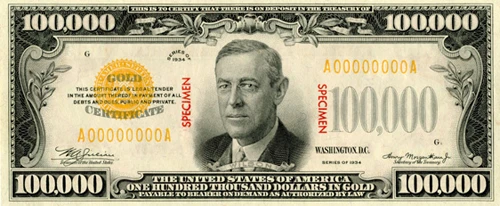
In 1934, Wilson's image appeared on the $100,000, which was legal tender but was never publicly circulated. Instead it was used to transfer funds between Federal Reserve banks.